Most content marketing plans fail before they start — not from a lack of ideas, but from a lack of structure. A content calendar full of disconnected topics isn’t a plan; it’s a list. Here’s a genuinely usable content marketing plan template, plus a worked example showing exactly how to fill it in.
Why Most Content Marketing Plans Don’t Work
A spreadsheet with a list of blog titles and publish dates isn’t a content marketing plan — it’s a schedule. A genuine plan connects every piece of content to a specific topic cluster, search intent, and business outcome. Without that structure, content gets published, gets a trickle of traffic, and never compounds into anything, because there’s no relationship between one piece and the next.
The Content Marketing Plan Template
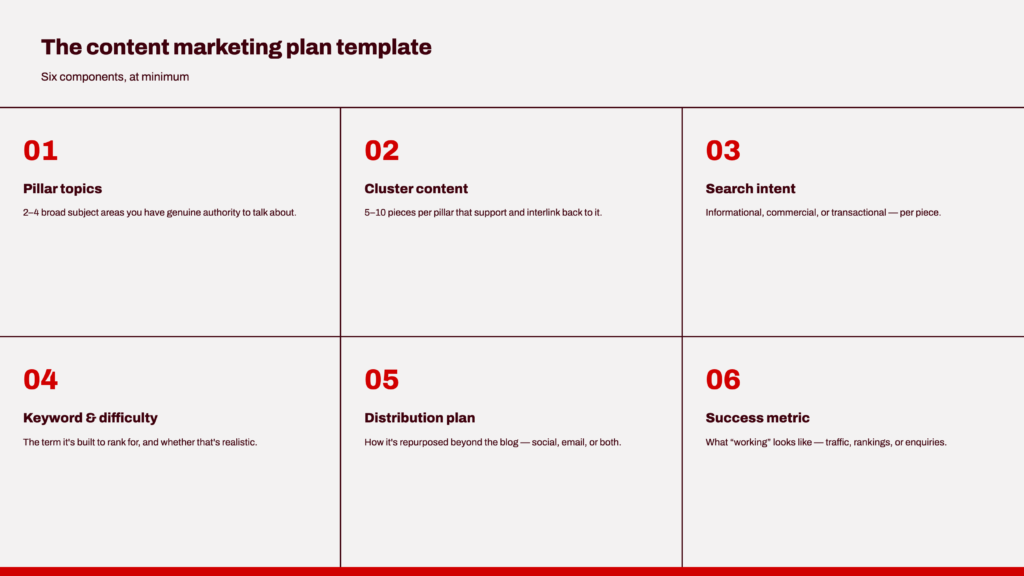
A workable content marketing plan needs these components, at minimum:
1. Pillar topics (2–4 to start). The broad subject areas your business has genuine authority to talk about — not everything you could write about, just what you’re genuinely positioned to say something useful on.
2. Cluster content under each pillar. For each pillar topic, 5–10 more specific pieces that support it and interlink back to it, building topical authority rather than scattering unrelated posts.
3. Search intent per piece. Is this piece informational (someone researching), commercial (someone comparing options), or transactional (someone ready to buy)? Mismatched intent is one of the most common reasons content doesn’t convert even when it ranks.
4. Target keyword and realistic difficulty. What term is this piece actually built to rank for, and is that realistic given your site’s current authority?
5. Distribution plan. How does this piece get used beyond the blog — repurposed into a social post, an email send, or both?
6. Success metric. What does “working” actually look like for this piece — traffic, rankings, enquiries, or all three?
Worked Example
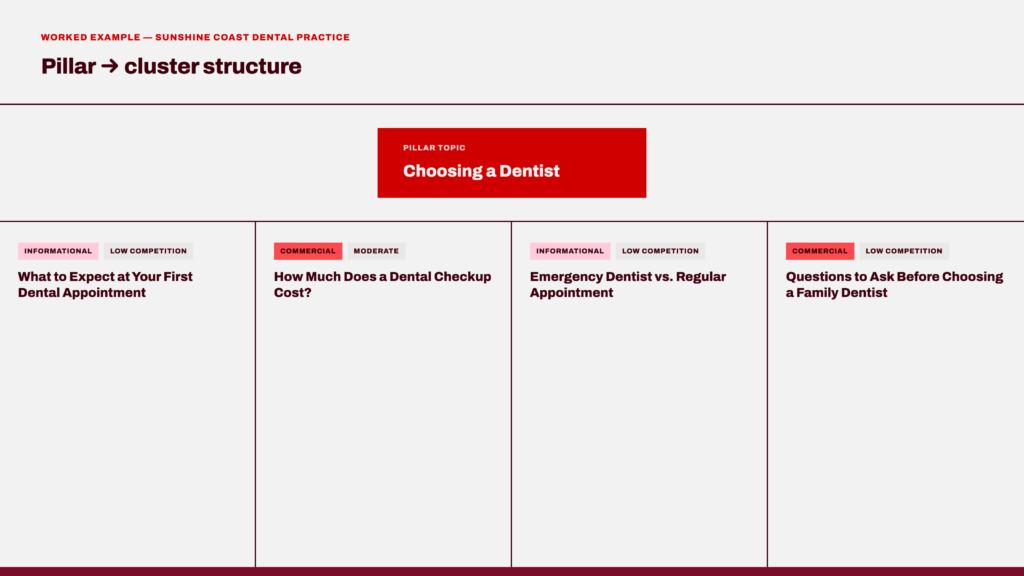
Business: a Sunshine Coast dental practice
Pillar topic: “Choosing a Dentist” (a genuine area of authority — patients research this before booking)
Cluster content under that pillar:
- “What to Expect at Your First Dental Appointment” (informational, low competition)
- “How Much Does a Dental Checkup Cost?” (commercial investigation, moderate competition)
- “Emergency Dentist vs. Regular Appointment: What’s the Difference?” (informational, low competition)
- “Questions to Ask Before Choosing a Family Dentist” (commercial investigation, low competition)
Search intent: Mostly informational and commercial investigation — this pillar sits earlier in the decision journey than a “book now” transactional page.
Distribution plan: Each piece gets a supporting social post (the FAQ-style pieces work particularly well as short-form video scripts) and gets referenced in the practice’s quarterly patient email newsletter.
Success metric: Organic traffic to the cluster, plus a tracked increase in “new patient” enquiry form submissions attributing this content as a landing page.
How to Use This Template for Your Own Business
Start with one pillar topic, not four. Build out 5–6 cluster pieces under it, publish consistently, and measure before expanding to a second pillar — a small, well-executed cluster consistently outperforms four half-finished ones.
Frequently Asked Questions
How many pillar topics should a small business start with?
One or two — a genuinely well-built cluster around a single pillar topic outperforms a scattered attempt at several pillars at once, especially for smaller sites with limited content capacity.
How often should a content marketing plan be updated?
Review it quarterly at minimum — search trends, seasonal demand and business priorities shift, and a plan that isn’t revisited tends to drift from what’s actually driving results.
Do I need a content marketing plan if I’m only posting on social media, not blogging?
Yes — the same pillar-and-cluster logic applies to social content, since a coherent content theme performs better than disconnected, one-off posts on any channel.
What’s the difference between a content calendar and a content marketing plan?
A content calendar is a scheduling tool — what gets published when. A content marketing plan is the strategy behind it — why each piece exists, what it’s meant to achieve, and how it connects to everything else.
Should I build this plan myself or get help?
Either works — this template is genuinely usable on your own. If you’d rather have it built and executed for you, that’s exactly what our content marketing services cover.