There is no single best LLM in 2026 — there’s a best LLM for your workload, budget, and deployment constraints. This guide breaks down the top large language models by benchmark performance, pricing, context window, and use case, using the latest data from independent evaluators like Artificial Analysis, LLM Stats, and Vellum’s LLM Leaderboard.
The frontier has fractured. Six or more models now sit within a few benchmark points of each other, and the gap between proprietary and open-weight models has narrowed to the point where cost, not raw intelligence, is often the deciding factor. What follows is a technical breakdown of where each model actually wins.
A note on timing: LLM rankings shift monthly. The figures below reflect publicly reported benchmarks and pricing as of July 2026. Before committing budget to a model, cross-check current numbers against a live leaderboard — the links throughout this article point to sources that update continuously.
What “Best LLM” Actually Means
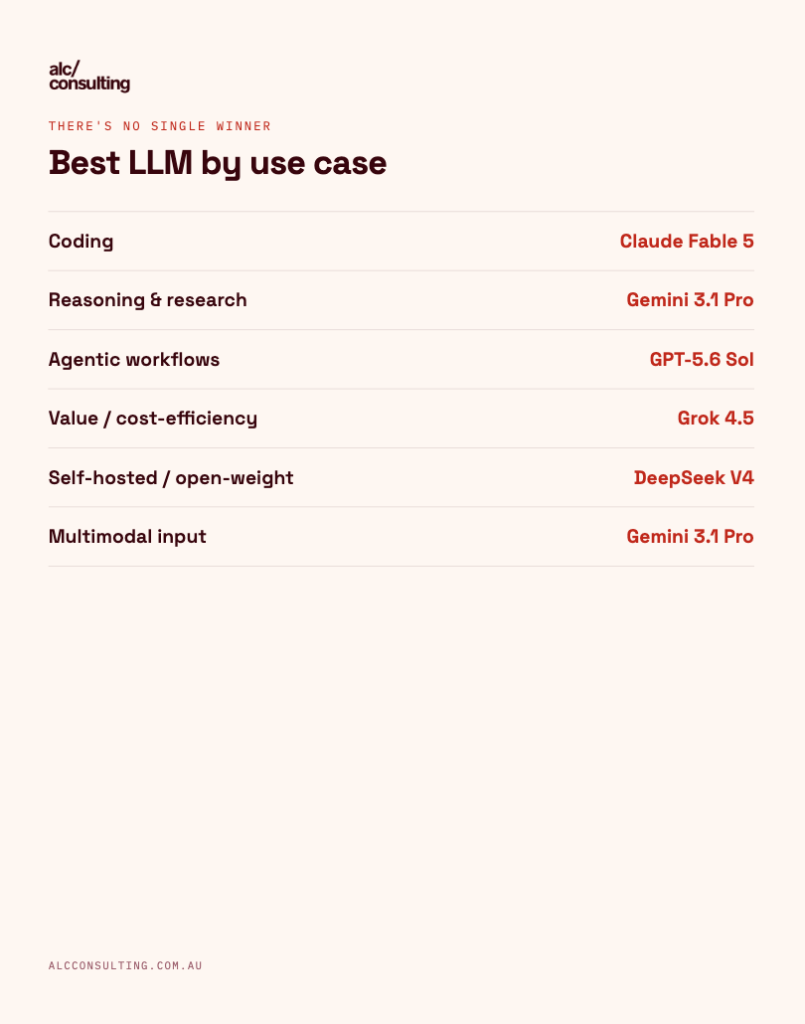
The best LLM is the model that maximises accuracy, speed, and cost-efficiency for a specific task — there is no universal winner. Coding, scientific reasoning, agentic workflows, and creative writing are each led by different models, and the right choice depends on latency tolerance, budget, and whether the workload can run on open-weight infrastructure.
Treating “best LLM” as a single-axis question is the most common mistake in model selection. A model that tops the SWE-bench Verified coding benchmark may be mediocre at long-context document retrieval. A model that wins on price-per-token may hallucinate more often on niche factual queries. Evaluating LLMs properly means separating the question into at least four sub-questions: raw capability, cost structure, deployment model, and task fit.
How LLMs Are Actually Benchmarked
LLM benchmarks are standardized tests that measure specific capabilities — reasoning, coding, math, or factual recall — and aggregate scores into composite indices so buyers can compare models without running their own evals. No single benchmark captures real-world performance, which is why serious evaluations combine several.
The benchmarks that matter most in 2026:
| Benchmark | What it measures | Why it matters |
|---|---|---|
| MMLU / MMLU-Pro | Broad academic knowledge across 57+ subjects | General knowledge baseline, though increasingly saturated |
| GPQA Diamond | Graduate-level science reasoning | Hardest widely-used reasoning benchmark; resistant to memorization |
| SWE-bench Verified | Real GitHub issue resolution | The standard for coding-agent capability |
| Humanity’s Last Exam (HLE) | Expert-level cross-domain reasoning | Designed specifically to avoid saturation as models improve |
| Artificial Analysis Intelligence Index | Composite of 9 evaluations across agents, coding, reasoning, and science | Closest thing to a single “overall” score |
| LMSYS Chatbot Arena | Blind human preference voting | Captures real-world “feel” that static benchmarks miss |
Benchmark scores should be read as directional, not absolute. Contamination (models trained on benchmark-adjacent data), version drift, and evaluation-harness differences mean a 2-point gap between two models is usually noise, not signal.
The Frontier Proprietary Models
Frontier proprietary LLMs from OpenAI, Anthropic, Google, and xAI currently lead on the hardest reasoning and agentic benchmarks, with the top models scoring within a few points of each other on the Artificial Analysis Intelligence Index. As of July 2026, Claude and GPT-class models trade the top spot depending on the benchmark category.
OpenAI: GPT-5.6 Sol
GPT-5.6 Sol is OpenAI’s current flagship, released July 2026 as the latest iteration of the GPT-5 family that launched in August 2025. It posts a 58.9% score on the Artificial Analysis Intelligence Index and leads on GPQA Diamond at 94.6% among some evaluators, alongside strong computer-use and agentic-tool performance carried over from GPT-5.4.
- Context window: ~1.05M tokens, 128K max output
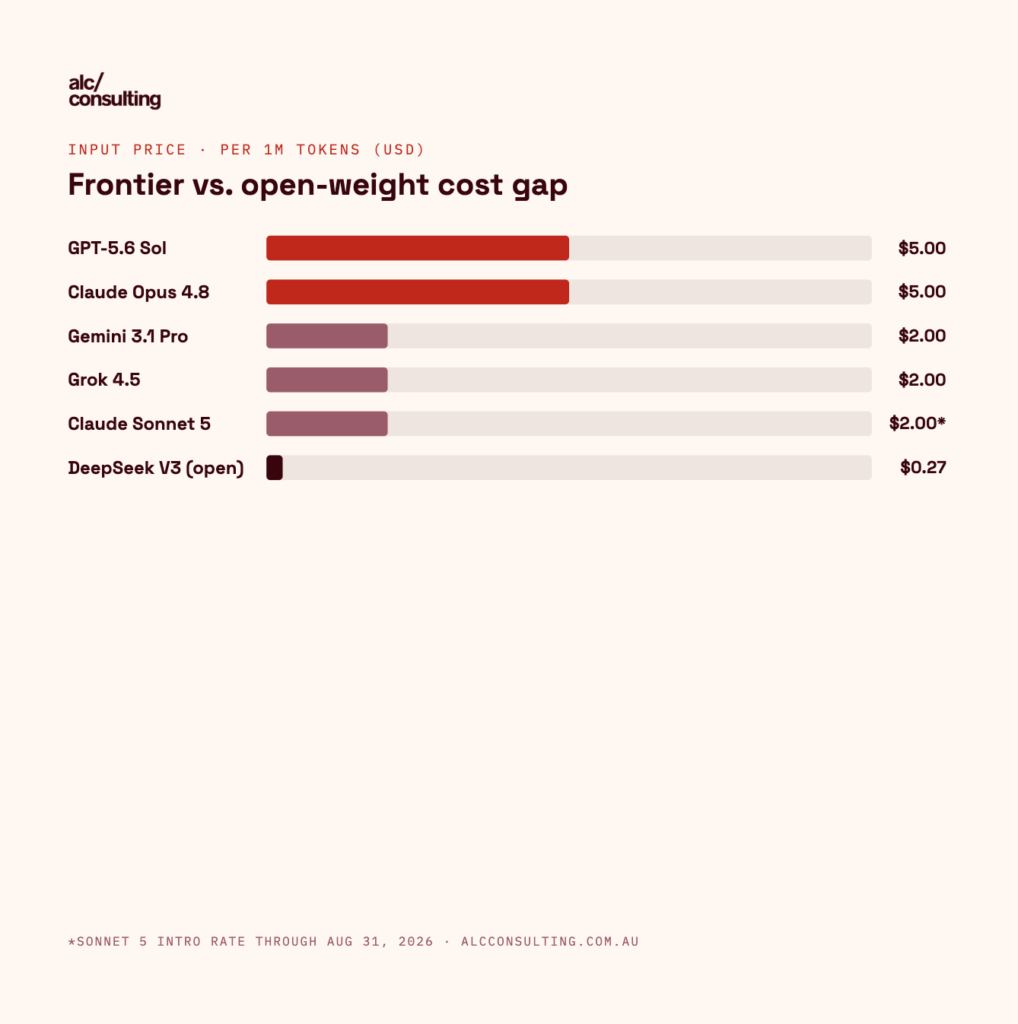
- Pricing: $5.00 per million input tokens / $30.00 per million output tokens at standard rates
- Strengths: Broad agentic tool use, computer-use tasks, general-purpose reliability
- Best for: Teams already standardized on the OpenAI ecosystem (Assistants API, Codex, ChatGPT Enterprise) who need consistent agentic behavior across tools
Anthropic: Claude Fable 5 and Claude Opus 4.8
Claude Fable 5 currently leads the Artificial Analysis Intelligence Index at roughly 59.9–60%, and separately leads frontier coding with a 95.0% score on SWE-bench Verified — a meaningful jump over the previous Claude Opus 4.8, which itself posted 87.6%. Claude also leads Humanity’s Last Exam among frontier models at 53.3%.
- Context window: 1M tokens at a flat rate (no surcharge for long context) on Opus 4.8 and Sonnet 4.6
- Pricing: Opus 4.8 at $5.00/$25.00 per million tokens (Fast Mode $10/$50); Claude Sonnet 5 at an introductory $2/$10 per million tokens through August 31, 2026, reverting to $3/$15 afterward
- Strengths: Coding accuracy, long-document reasoning, agentic coding workflows (Claude Code)
- Best for: Software engineering teams, technical due diligence, and any workflow where output correctness matters more than raw speed
Google: Gemini 3.1 Pro (and the incoming Gemini 3.5 Pro)
Gemini 3.1 Pro leads scientific and abstract reasoning benchmarks, posting 94.3% on GPQA Diamond and 77.1% on the notoriously difficult ARC-AGI-2 abstract reasoning benchmark — a category where most other frontier models lag well behind.
- Context window: 1M tokens standard; Gemini 3.5 Pro (previewed May 2026, expected to ship with a 2M-token window) will roughly double that
- Pricing: $2.00/$12.00 per million tokens under 200K-token prompts, doubling to $4.00/$18.00 above that threshold
- Strengths: Scientific reasoning, native multimodal input (video, audio, image, text), deep integration with Google Workspace and Cloud
- Best for: Research-heavy workflows, multimodal document processing, and organizations already on Google Cloud infrastructure
xAI: Grok 4.5
Grok 4.5 is notable less for topping leaderboards and more for value: it’s the cheapest model in the top 10 by GPQA Diamond score, at roughly $2.00 per million input tokens, while remaining competitive on reasoning benchmarks.
- Strengths: Real-time data access (via X/Twitter integration), competitive reasoning at lower cost than Claude or GPT-class models
- Best for: Teams that want frontier-adjacent reasoning without frontier-tier pricing, or applications needing live/current-events awareness
Open-Weight Models: How Close Have They Gotten?
Open-weight models like DeepSeek, Qwen, and Llama have closed most of the capability gap with proprietary frontier models on coding and math benchmarks, while remaining dramatically cheaper to run at scale. The gap that remains is concentrated in agentic tool use and the hardest reasoning benchmarks, not raw knowledge or coding ability.
| Model | Notable benchmark | Approx. API pricing (per 1M tokens) | License model |
|---|---|---|---|
| DeepSeek V3 / V4 | 88.5% MMLU, 59.1% GPQA (V3); V4 Flash at $0.14 in / $0.28 out | $0.27/$1.10 (V3) | Open weights |
| Qwen3 235B | 77.2% GPQA Diamond, 85.7% AIME ’24 | Low-cost via Alibaba Cloud or self-host | Open weights |
| Llama 4 Maverick | 85.5% MMLU | Free to self-host | Open weights (Meta license) |
| MiniMax M2.5 | 80.2% SWE-bench Verified | Low-cost API | Open weights |
| Kimi K3 | ~57.1% Artificial Analysis Intelligence Index | Low-cost API | Open weights |
The practical implication: a team with real budget constraints in 2026 has a credible path to near-frontier coding and reasoning performance without paying frontier-tier prices. DeepSeek V4 Pro and Kimi K2.6-class models are increasingly cited as legitimate production choices, not just budget fallbacks — particularly for teams willing to self-host and manage their own GPU infrastructure.
Self-hosting isn’t free, though. Open weights remove the per-token API cost but shift the burden to infrastructure: cloud GPU rental for a mid-sized open-weight model typically runs $0.50–$5.00 per hour depending on model size and provider, before accounting for engineering time to deploy and maintain the serving stack.
Best LLM by Use Case
Best LLM for Coding
Claude currently leads coding benchmarks, with Claude Fable 5 and Claude Opus 4.8 topping SWE-bench Verified at 95.0% and 87.6% respectively. For high-frequency, lower-complexity coding tasks like small edits and Q&A, Claude Haiku 4.5 offers a faster, cheaper alternative from the same family. Among open-weight models, MiniMax M2.5’s 80.2% SWE-bench score makes it the strongest self-hostable option for coding-heavy workloads.
Best LLM for Reasoning and Research
Gemini 3.1 Pro leads scientific and abstract reasoning (GPQA Diamond, ARC-AGI-2), while Claude leads on Humanity’s Last Exam and general composite reasoning scores. For research workflows involving primary-source synthesis and long documents, the combination of a 1M-token context window and strong reasoning scores makes both Gemini and Claude reasonable defaults — the choice often comes down to whether the workflow needs native multimodal input (favoring Gemini) or coding-adjacent reasoning (favoring Claude).
Best LLM for Business and Agentic Workflows
GPT-5.6 Sol leads on breadth of agentic tool use and computer-use tasks, making it a strong default for teams building multi-step automation across varied tools. DeepSeek V4 Pro and similar open-weight models lead on cost-to-performance ratio for high-volume, lower-stakes business automation where per-token cost compounds quickly at scale.
Best LLM for Cost-Sensitive and Local Deployment
For teams asking about the best local LLM or best free LLM, the answer runs through open-weight models: Llama 4, Qwen3, and DeepSeek can all be self-hosted at zero licensing cost, with quality that’s now competitive with 2024-era proprietary frontier models. The tradeoff is infrastructure — running a 200B+ parameter model locally requires meaningful GPU investment, so “free” really means “capital-and-engineering-time instead of API spend.”
Best LLM for Writing, Translation, and Multimodal Tasks
Creative writing and translation quality is less benchmark-driven and more a matter of stylistic fit — most frontier models (GPT, Claude, Gemini) perform well here, and the differentiator is usually tone control and instruction-following rather than raw capability. For multimodal tasks spanning image, video, and audio input, Gemini’s native multimodal architecture currently gives it an edge over models that bolt on vision/audio via separate encoders.
Technical Factors That Matter More Than Leaderboard Rank
Context Window
A model’s context window is the maximum amount of text (measured in tokens) it can process in a single request, and it directly determines whether a model can handle long documents, large codebases, or extended conversation history without truncation. Most 2026 frontier models now offer 1M-token windows, with Gemini 3.5 Pro pushing to 2M. Watch for tiered pricing above certain thresholds — Gemini 3.1 Pro’s cost doubles past 200K tokens, which changes the economics of long-context use cases significantly.
Cost Per Token
Input and output tokens are priced separately, and output tokens are typically 4-6x more expensive than input tokens across most providers. A model that looks cheap on input pricing can still be expensive in production if your workload is output-heavy (e.g., long-form generation, code generation). Always model total cost against your actual input:output token ratio, not the headline price.
Data Privacy and Deployment Model
Organizations with strict data residency or compliance requirements need to evaluate whether a model is available via a private cloud deployment (e.g., Anthropic and OpenAI both offer enterprise agreements with data-handling guarantees) or whether self-hosting an open-weight model is the only path to full data control. This is frequently the deciding factor for regulated industries — finance, healthcare, and legal — where “best” is constrained by “permitted” before it’s a question of capability at all.
Hallucination and Reliability
Benchmark scores measure capability under test conditions; they don’t fully capture hallucination rates in open-ended, real-world use. The Artificial Analysis and Vellum leaderboards both track reliability-adjacent metrics alongside raw intelligence scores, and it’s worth checking model cards directly for stated hallucination or refusal rates before deploying in customer-facing contexts.
A Framework for Choosing
Rather than asking “which LLM is the best,” a more useful question is a four-part checklist:
- What’s the primary task? Coding, reasoning/research, agentic automation, or general writing each favor different models.
- What’s the cost ceiling at production volume? Model per-token cost against realistic monthly volume, not the sticker price on a landing page.
- What are the deployment constraints? Data residency, compliance, and latency requirements may rule out API-only models entirely.
- Is this a single-model or multi-model architecture? Many production systems in 2026 route requests across multiple models by task complexity — using a cheap, fast model for simple queries and a frontier model only when the task demands it — rather than committing to one model for everything.
That last point reflects where the market has actually moved: the “best LLM” question is increasingly answered with a routing strategy rather than a single vendor selection, and organizations building serious AI infrastructure are architecting for multi-model flexibility rather than locking into one provider’s ecosystem.
Frequently Asked Questions
What is the best LLM right now? As of July 2026, Claude Fable 5 leads the Artificial Analysis Intelligence Index and the SWE-bench Verified coding benchmark, with GPT-5.6 Sol and Gemini 3.1 Pro close behind on different benchmark categories. There is no single best model across every task.
What is the best open source LLM? DeepSeek V3/V4, Qwen3 235B, and Llama 4 Maverick are the leading open-weight models in 2026, each leading different benchmarks (general knowledge, math/reasoning, and MMLU, respectively).
What is the best LLM for coding? Claude Fable 5 and Claude Opus 4.8 currently lead SWE-bench Verified. MiniMax M2.5 is the strongest open-weight option for teams that need to self-host.
What is the best free LLM? Open-weight models (Llama 4, Qwen3, DeepSeek) are free to download and self-host, though running them requires GPU infrastructure. Several providers also offer limited free tiers of proprietary models.
How often do LLM rankings change? Meaningfully — major labs now ship model updates every 4-8 weeks, and leaderboard positions shift with each release. Treat any static comparison, including this one, as a snapshot rather than a permanent ranking, and check a live leaderboard before making a purchasing decision.
Sources and further reading: Artificial Analysis Intelligence Index, LLM Stats Leaderboard, Vellum LLM Leaderboard, SWE-bench, LMSYS Chatbot Arena, Stanford HAI 2026 AI Index Report.