
On this page
Not sure where your site stands?
Get a free audit from the person who’d do the work.
On this page
A good SEO report shows whether organic search is bringing in more enquiries or sales, measured from a fair starting point. To read one, check the comparison first, separate organic search from other channels, then work up from rankings to revenue.
Who this guide is for
This guide is for business owners who pay for SEO, or are thinking about it, and want to know whether it’s working. You don’t need any technical knowledge. You need your latest report, the same report from a few months ago if you have it, and about 20 minutes.
These questions aren’t a trap for your provider. A good one will welcome them, and some answers will be “it’s too early to tell”. What matters is whether you get a clear answer in plain English.
Is the comparison fair?
1. What date does the report start from?
Growth depends on where you start measuring. If a report begins just after a big drop, such as a website move or a Google update, almost anything will look like an improvement.
- A good answer: The report shows a longer history, and explains any big rises or falls.
- Watch out for: Every chart starts on the day the provider began, with nothing about what happened before.
2. How does this compare with the same month last year?
Many businesses have busy and quiet seasons. Comparing with last month can make a normal seasonal rise look like an SEO win, or a seasonal dip look like a failure.
- A good answer: Year-on-year figures appear alongside month-on-month figures.
- Watch out for: Only month-on-month comparisons, especially around your busy season.
3. Is this organic search, or all traffic?
Total sessions can include paid ads, email, social media and people typing in your web address. If your ad spend went up, total traffic can rise even when SEO hasn’t improved.
- A good answer: Organic search has its own figures for visits, enquiries and sales.
- Watch out for: One large traffic number, with no breakdown by channel.
Do the rankings matter?
4. How many keywords are on page one?
Most clicks go to the first page of results. A report can show hundreds of new keywords that sit on page three or lower, where very few people ever look.
- A good answer: Keywords are broken down by position, and page one is tracked over time.
- Watch out for: A growing total keyword count, with no breakdown by position.
5. Are these searches my customers would actually make?
Ranking first for a term nobody uses to hire you won’t change your business. Searches for your own business name are also less useful as proof, because those people were already looking for you.
- A good answer: The tracked keywords are tied to your main services and locations, and exclude or separate your business name.
- Watch out for: Rankings for loosely related terms, or a keyword list you’ve never been shown.
Did it produce business?
6. What exactly counts as a conversion?
Analytics tools let people count almost anything as a “key event”, including page views, button clicks and items added to a cart. Those can be useful signals, but they aren’t customers.
- A good answer: The report lists what it counts, and separates enquiries and purchases from smaller actions.
- Watch out for: A large “conversions” number nobody can break down.
7. How many enquiries or sales came from organic search?
This is the question the whole report should help you answer. If the figure can’t be shown yet, the next step is to set up the tracking that will show it.
- A good answer: A monthly count from organic search, compared with your starting point and last year.
- Watch out for: Lots of visibility charts and no enquiry or sales figure anywhere.
8. Were they the right kind of enquiries?
Ten enquiries that become paying clients beat fifty that don’t. Your report can’t always see this on its own, so it may need a short conversation or your CRM data.
- A good answer: Your provider asks you which leads turned into work, and uses that to guide the plan.
- Watch out for: Lead quality never comes up.
Was the work useful?
9. What was done, and what changed because of it?
A list of tasks shows activity, but it doesn’t show results. You’re looking for a link between the work and what moved, or an honest note that it’s too early to know.
- A good answer: Tasks are explained in plain English and connected to a measured result or an expected one.
- Watch out for: Vague phrases like “ongoing optimisation”, with no specifics.
10. What is the priority next month, and why that first?
Good SEO involves choosing what not to do. The answer shows whether someone is thinking about your business or just repeating a package.
- A good answer: Two or three priorities with a clear reason, tied to enquiries or sales.
- Watch out for: The same list every month, whatever the results show.
A real example: traffic up, sales down
I recently read a monthly SEO report for a business owner who wanted a second opinion. It looked positive at first glance. These questions told a different story.
| What the report showed | What the questions revealed |
|---|---|
| Total visits up by more than 150% | More than half of the latest month’s visits came from paid ads, and the number of buyers had fallen by more than a third |
| Steady progress since the start date | The start date came after a big drop in organic visibility, so the drop wasn’t in the report |
| A big rise in total keywords | Almost all of the new keywords sat outside the top 20, and page-one keywords had fallen |
| Plenty of key events | Key events included add-to-carts, and the report didn’t show organic revenue |
Nothing in that report was false. The figures were accurate, but it couldn’t answer the main question: is organic search bringing in more sales?
How to score your report
Give your report one point for every question it answers clearly, or that your provider can answer when you ask.
| Score | What it suggests | What to do |
|---|---|---|
| 8 to 10 | Your reporting is doing its job | Keep asking questions 7 and 10 each month |
| 5 to 7 | Useful, but with gaps | Send your provider the missing questions and ask for them in next month’s report |
| 0 to 4 | You can’t tell whether SEO is working | Book a review meeting, and consider an independent second opinion |
Be fair about timing. SEO can take time, and enquiries are often among the last things to move. Early on, a good provider may be fixing the foundations and can say so. The test is whether they can tell you what they expect to change, roughly when, and how you’ll both know.
What to do if the answers aren’t clear
- Ask in writing. Send your provider the questions you couldn’t answer. It gives them a fair chance to respond.
- Ask for access. Your Google Analytics, Search Console and Google Business Profile should belong to you. Make sure you can log in to them.
- Agree on the measure. Decide together which enquiry or sales figure the work will be judged on, and from what starting point.
- Set a review date. Give the changes a reasonable time to appear. If you’re still unsure, get a second opinion.
How ALC applies this
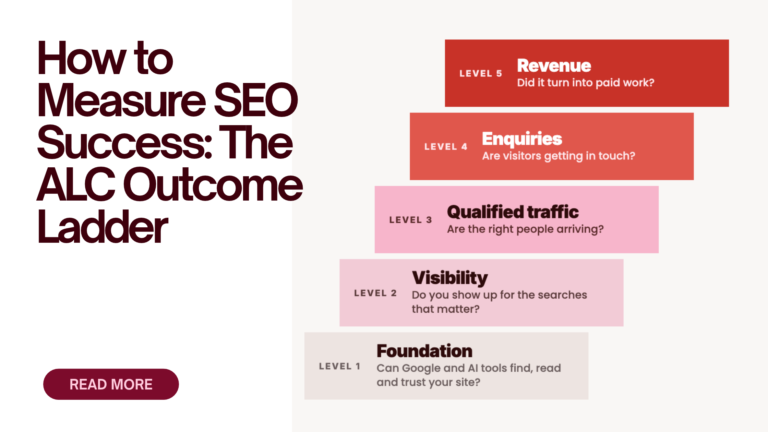
These questions come from the way I report for my own clients. Under the No Surprises Standard, I record your starting point in the first week, measure every report against it, and read the results through the ALC Outcome Ladder. Your reports come from me and focus on enquiries and conversions.
Frequently asked questions
What should an SEO report include?
At a minimum, it should show organic search visits, enquiries or sales from organic search, keyword positions for your main services, the work completed, and next month’s priorities. These should be compared with your starting point and the same period last year.
How often should I get an SEO report?
Monthly suits most small and medium businesses. SEO results can move slowly, so look for trends over several months rather than reacting to a single report.
Is more keywords always a good sign?
No. New keywords often appear in low positions that get very few clicks. Check how many are on page one and whether they relate to what you sell.
What is a key event in Google Analytics?
A key event is an action marked as important in Google Analytics 4. It can be a purchase or enquiry, but it can also be a smaller action, so ask what’s included.
How long should I wait to see SEO results?
It depends on your market, your competitors and the state of your website. Ask your provider what they expect to change first and roughly when, then check against that.
Want a second opinion on your report?
Book a free strategy session and bring your latest report. I’ll tell you what I’m seeing in plain English.

WRITTEN BY
Annabelle Cochrane
MANAGING DIRECTOR & SEO SPECIALIST
Annabelle holds a Bachelor of Business (Marketing) from QUT and works directly with every ALC Consulting client. She’s based on the Sunshine Coast and works with businesses across Australia.