A local SEO checklist turns a vague goal like “rank higher near me” into a specific list of fixes you can knock out this month. This local SEO checklist covers 72 action items across your Google Business Profile, website, citations, reviews, and content, plus the broader digital marketing checklist basics that support all of it. Work through each section in order. Most small businesses see measurable movement in local rankings within 60 to 90 days of consistent execution.
How to use this checklist: Print or copy each section into a project tracker. Tackle Google Business Profile and citations first — they’re the fastest wins. Website and technical items take longer but compound over time.
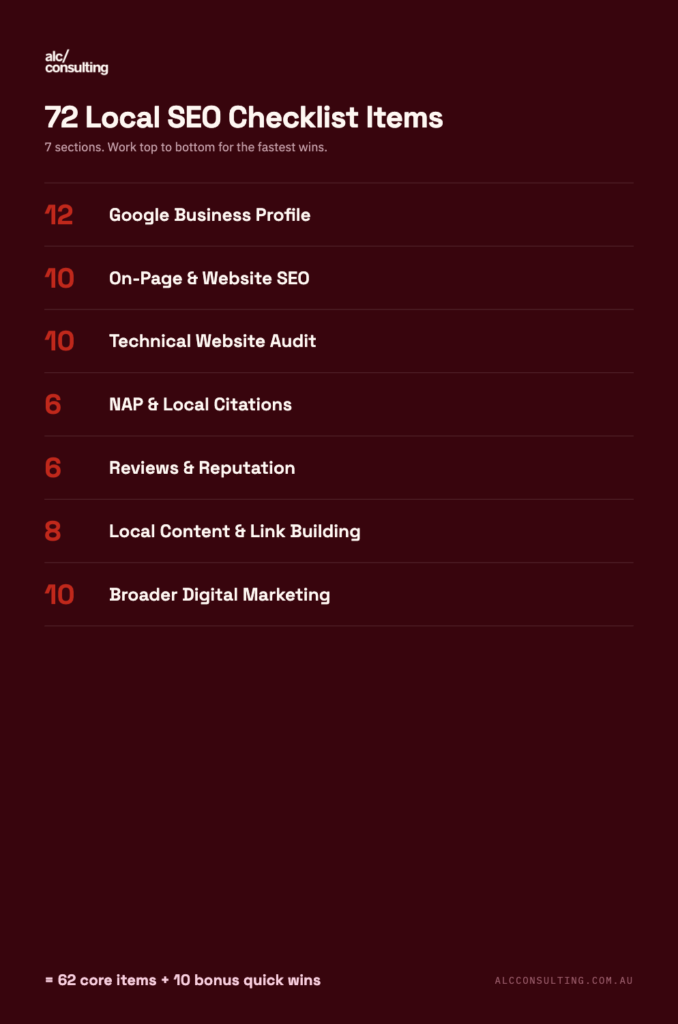
Google Business Profile Checklist (12 Points)
Your Google Business Profile (GBP) is the single highest-leverage asset in local SEO. Industry data from BrightLocal puts primary category selection alone at roughly a third of local ranking weight. Before touching anything else, confirm every field below is complete, accurate, and matches what a customer would actually type into Google.
- Claim and verify your listing. An unverified profile won’t show up in Maps results at all.
- Choose the most specific primary category available. “Italian Restaurant” outranks “Restaurant” for Italian food searches.
- Add 3–5 relevant secondary categories to capture adjacent searches without diluting relevance.
- Write a complete business description that works your primary keyword in naturally, not stuffed.
- List accurate hours, including holiday and seasonal hours. Wrong hours hurt trust signals and in-person conversions.
- Set your service area if you work from a base location rather than a storefront.
- Upload at least 10 high-quality photos — exterior, interior, team, and product/service shots.
- List every service or product with a short description and, where possible, pricing.
- Turn on messaging and monitor the Q&A tab so unanswered questions don’t sit for weeks.
- Post a GBP update weekly. Profiles that stay active outperform ones that go quiet.
- Add a booking or appointment link if your business takes reservations or scheduled visits.
- Confirm your name, address, and phone number (NAP) match your website exactly, down to abbreviations.
On-Page & Website SEO Checklist (10 Points)
On-page local SEO means structuring your website so Google can confidently associate specific pages with specific places and services. Get this right and a single well-built page can outrank competitors with far more backlinks. Get it wrong and your GBP work has nothing to reinforce it.
- Build a dedicated page for each city or service area you serve, not one generic “service area” page.
- Include your primary keyword and city in the title tag of every local page.
- Write a meta description with a clear call to action for each key page.
- Use your primary keyword in the H1, and only one H1 per page.
- Add LocalBusiness schema markup so search engines can parse your NAP, hours, and reviews directly.
- Display your NAP in the site footer on every page, matching your GBP exactly.
- Embed a Google Map on your contact and location pages.
- Confirm the site is fully mobile-responsive — most local searches happen on phones.
- Link location and service pages to each other so authority flows between them.
- Put a clear call to action (call, book, or contact) above the fold on every local landing page.
Technical Website Audit Checklist (10 Points)
A website audit checklist exists to catch the technical issues that quietly cap your rankings no matter how good your content is. Run this list quarterly, not just once — technical debt accumulates as fast as you add pages.
- Check Core Web Vitals (LCP, INP, CLS) in Google Search Console and fix anything flagged “poor.”
- Confirm HTTPS/SSL is active sitewide, with no mixed-content warnings.
- Submit an updated XML sitemap to Search Console after any major site change.
- Review robots.txt to make sure it isn’t accidentally blocking pages you want indexed.
- Crawl the site for broken links and 404 errors and fix or redirect them.
- Clean up redirect chains — more than one hop slows crawling and dilutes link equity.
- Check for duplicate content and confirm canonical tags point to the correct version of each page.
- Compress images and add descriptive alt text to every image on the site.
- Confirm page load time is under three seconds on mobile.
- Validate structured data with Google’s Rich Results Test and fix any errors or warnings.
NAP & Local Citations Checklist (6 Points)
- Get your name, address, and phone number listed identically across the top 20 directories in your industry.
- Claim Apple Maps, Bing Places, and Yelp, not just Google.
- Find and fix duplicate or outdated listings that confuse search engines about which is authoritative.
- List on industry-specific directories relevant to your trade or profession.
- Join your local chamber of commerce or trade association for a credible, high-authority citation.
- Re-audit citations every quarter — directories change formats and data can drift out of sync.
Reviews & Reputation Checklist (6 Points)
- Build a simple system for asking for reviews at the natural point of service completion.
- Respond to every review within 48 hours, positive or negative.
- Address negative reviews professionally and specifically rather than with a generic template.
- Feature strong reviews on your website, ideally with schema markup.
- Monitor review velocity. A steady trickle of new reviews signals an active, trustworthy business.
- Mine reviews for language customers actually use and feed it into your content and FAQ pages.
Local Content & Link Building Checklist (8 Points)
- Publish blog content that answers real local questions your customers search for.
- Give each location page real depth — 500+ words of unique, useful content, not boilerplate.
- Pursue local link building through sponsorships, partnerships, and community involvement.
- Contribute guest posts to local news sites or industry blogs.
- Participate in community events and ask for a mention or link in the recap.
- Pitch local press when you have real news — a launch, milestone, or local angle.
- Build an internal linking structure connecting blog content to service and location pages.
- Add FAQ schema to service pages to capture featured snippets and AI Overview citations.
The Broader Digital Marketing Checklist (10 Points)
Local SEO doesn’t operate in isolation, it works better when the rest of your digital marketing checklist is in order. These 10 items sit outside pure SEO but directly affect whether local traffic converts and whether you can prove ROI.
- Connect Google Analytics 4 and Search Console and check them monthly, not just at setup.
- Set up conversion tracking for calls, form fills, and bookings.
- Claim and link your core social profiles (Facebook, Instagram, LinkedIn) to your website and GBP.
- Add an email capture point to your site to build a first-party marketing list.
- Audit any running Google or Meta ads for wasted spend and message match with your landing pages.
- Keep branding (logo, colors, messaging) consistent across your site, GBP, and social profiles.
- Set a monthly reporting cadence so you can see what’s actually moving the needle.
- Benchmark against two or three direct competitors at least once a quarter.
- Run a basic accessibility check (contrast, alt text, keyboard navigation) — it helps rankings and reach.
- Confirm your site has backups and a security plan in place before an issue forces the question.
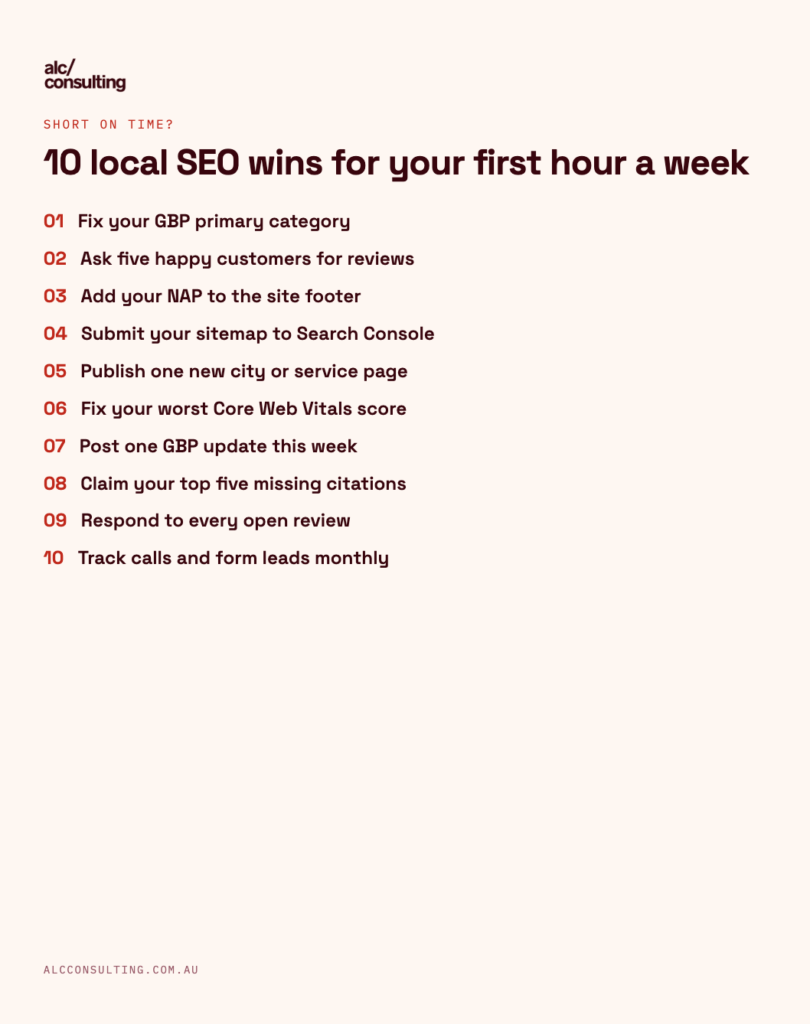
Bonus: Local SEO Tips If You’re Short on Time (10 Points)
If you only have an hour a week, these local SEO tips deliver the most impact for the least effort. Work down the list in order — each one builds on the last.
- Fix your GBP primary category — it’s the single highest-impact change on this list.
- Ask five happy customers for reviews this month.
- Add your NAP to your site footer if it isn’t there already.
- Submit your sitemap to Google Search Console.
- Publish one new city or service landing page.
- Fix your single worst Core Web Vitals score.
- Post one GBP update per week, even a simple one.
- Claim your top five missing citations.
- Respond to every open, unanswered review.
- Track calls and form leads monthly so you know what’s working.
Frequently Asked Questions
How long does local SEO take to show results?
Most small businesses see initial movement in Google Business Profile visibility within 4–8 weeks and meaningful organic ranking improvement within 3–6 months, depending on competition and how much of this checklist was already in place.
Do I need to hire an agency for local SEO?
Not necessarily. A motivated owner can work through this checklist independently. An agency helps most when you lack the time to maintain it consistently or compete in a crowded local market where technical and content gaps are harder to close alone.
What’s the difference between local SEO and general SEO?
General SEO targets rankings anywhere; local SEO specifically targets map-pack and “near me” results tied to your Google Business Profile, citations, and location-based content. Small businesses with a physical location or defined service area should prioritise local SEO first.
Is this checklist the same as a local SEO audit?
Functionally, yes — a local SEO audit is a structured assessment of the same areas this checklist covers (Google Business Profile, on-page signals, technical health, citations, reviews, and content). The difference is mostly about framing: an audit is often something you pay an agency to run and interpret for you, whereas this checklist is designed so you can run the same assessment yourself. If you’d rather have a professional audit — including a written, prioritised report and competitor comparison — see our SEO Audit Service.
Ready to Turn This Checklist Into Rankings?
Working through 72 checklist items on top of running a business is a lot to take on alone. ALC Consulting helps small businesses prioritise the items that move rankings fastest for their specific market and skip the ones that don’t matter yet.
Schedule your free local SEO audit and consultation with ALC Consulting