
Google AI Overviews now appear in 68% of local searches, compared to just 39% for traditional local packs. If your business isn’t showing up inside that AI-generated answer, you’re invisible for the majority of local queries, even if you rank #1 in the map pack. Getting cited in Google AI Overviews requires a different playbook than classic local SEO: complete entity data, fact-dense location pages, review velocity, and off-site citation signals that AI systems trust. Here’s the exact blueprint, backed by the studies that actually measured what works.
Key takeaways
- AI Overviews and local pack rankings are separate systems. You can earn one without the other.
- Informational and cost-related local queries trigger AI Overviews 92–97% of the time. Transactional searches trigger them far less.
- Being cited is now worth more than ranking #1: cited sources see roughly a 35% CTR lift, while non-cited competitors absorb the full traffic loss.
- Schema markup correlates with citations but didn’t cause them in Ahrefs’ controlled test. Treat it as hygiene, not a silver bullet.
- 77% of AI citations come from off-site sources (reviews, Reddit, YouTube, directories), not your own website.
What Are Google AI Overviews, and Why Do They Matter for Local Search?
Google AI Overviews are AI-generated summaries that appear above traditional search results, synthesizing an answer from your Google Business Profile, website, reviews, and third-party sources instead of listing ten blue links. For local businesses, they now answer more queries than the map pack does, and they can cite you even if you never appear in the 3-pack.
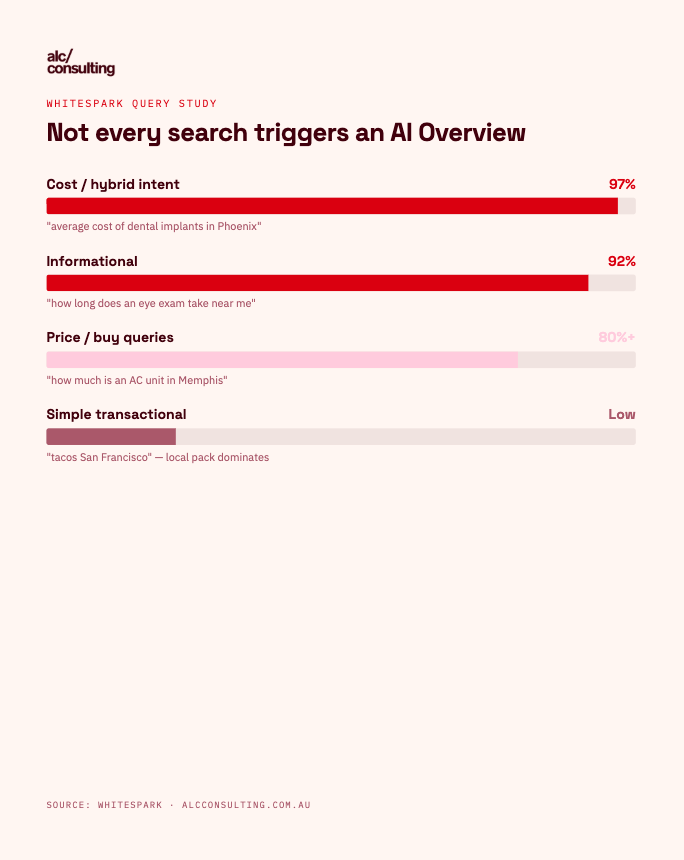
That last point trips up most business owners. Local pack ranking and AI Overview citation run on different signals. A Whitespark study tracking real local queries found the split isn’t uniform. It depends heavily on what the searcher is actually trying to do:
| Query type | Example | AI Overview trigger rate |
|---|---|---|
| Simple transactional | “tacos Sunshine Coast” | Low — local pack dominates |
| Informational | “how long does an eye exam take near me” | 92% |
| Cost/hybrid intent | “average cost of dental implants in Phoenix” | 97% |
| Price/buy queries generally | “how much is an AC unit in Memphis” | 80%+ |
If customers research your category before they buy, you’re competing in AI Overview territory almost every time. And your competitive set just expanded: you’re no longer just competing with the business three blocks away. You’re competing with anyone, anywhere, whose content answers the question more precisely than yours. This is the exact gap our local SEO services are built to close for Sunshine Coast businesses.
Why a Citation Is Now Worth More Than a #1 Ranking
A direct answer first: earning a citation inside an AI Overview delivers roughly a 35% click-through-rate boost compared to pre-AI-Overview performance, while businesses that rank well but don’t get cited absorb the full traffic decline instead. That reversal is the single biggest reason local businesses need to treat AI citation as its own metric, not a byproduct of rankings.
The data on this is consistent across independent studies, not just one source:
- Position-1 organic listings saw CTR drop by roughly 34.5% when an AI Overview appeared above them in Ahrefs’ original 300,000-keyword study — and a follow-up study using the same methodology found that decline had widened to 58% less than a year later. The gap is accelerating, not stabilizing.
- A controlled Pew Research Center study of nearly 69,000 real queries found click rates fall from 15% to 8%, a 46.7% relative decline, when an AI Overview is present.
- Sites that are cited inside the Overview reverse that pattern entirely, gaining CTR instead of losing it
- Branded queries get an 18.68% CTR boost from AI Overviews; non-branded queries lose 19.98%. Brand strength is now a direct hedge against AI Overview traffic loss.
The practical implication: if your local content strategy is still optimised purely for blue-link rankings, you’re optimizing for a shrinking slice of visibility. Citation is the new currency.
The Local AI Citation Framework: 7 Pillars
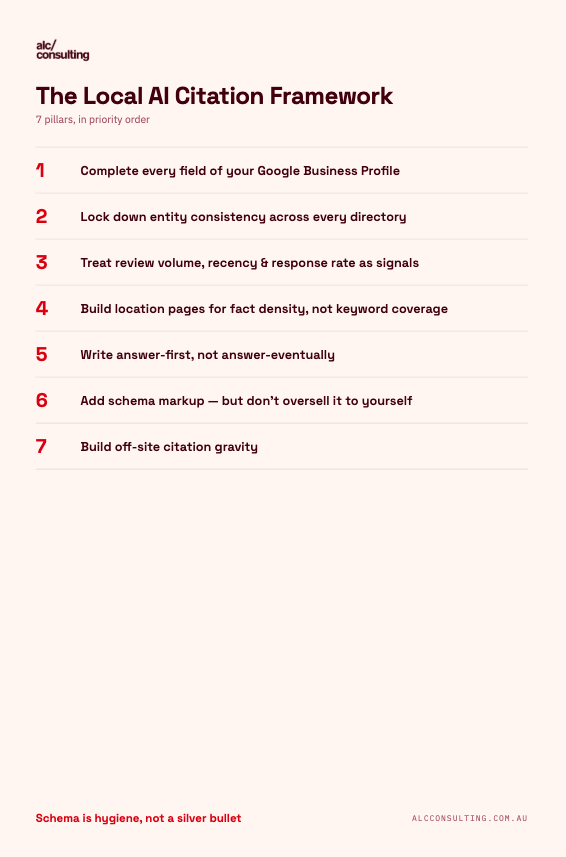
Most guides on this topic collapse into a generic checklist — “complete your GBP, get reviews, add schema.” Those are necessary, but they’re table stakes, not a strategy. Here’s the fuller framework, in priority order, including what recent controlled studies say actually moves the needle versus what’s commonly overstated.
1. Complete Every Field of Your Google Business Profile
Your Google Business Profile remains the single most-referenced data source for AI-generated local answers. Incomplete profiles give the AI nothing to extract with confidence.
Fill in, and keep current: business description, individual descriptions for every service (not one generic list), hours, service area, accepted payments, and product attributes. Post updates weekly and answer every question in the Q&A section yourself before a competitor or random user does it for you with inaccurate information.
2. Lock Down Entity Consistency Across Every Directory
AI systems cross-reference your business against every source they can find before citing you. If your name, address, phone number, category, or description differs between Google, Yelp, Bing, Apple Maps, Facebook, and industry directories, the AI’s confidence in your entity drops, and so does citation probability.
Audit NAP and category consistency quarterly across at least the five to ten directories most relevant to your industry. This is unglamorous work, but it’s one of the most consistently overlooked citation levers in every audit that studies this. Our 72-point local SEO checklist walks through exactly which directories and fields to check first.
3. Treat Review Volume, Recency, and Response Rate as Ranking Signals
AI Overviews frequently cite review summaries when answering “which business should I choose” queries. Volume matters, but recency matters more: a business with 40 reviews from the last two months outperforms one with 400 reviews that stopped coming in three years ago. Response rate is a trust signal too — respond to every review, positive or negative, within 48 hours.
Build this into an actual process rather than hoping it happens: text or email a review request within 24 hours of service completion, every time.
4. Build Location Pages for Fact Density, Not Keyword Coverage
The cookie-cutter location page — same template, city name swapped, “we serve Nashville with pride” — used to produce mediocre-but-acceptable results. AI systems now recognize this pattern instantly and skip it, because there’s no extractable fact in it.
Every location page needs, at minimum:
- NAP, service area, and hours in table format (tables give AI a labeled, structured data point instead of a paragraph it has to interpret).
- FAQs specific to that market: local permit questions, regulations, climate-specific concerns, not generic questions copy-pasted across every city page.
- Testimonials from customers in that specific city, with neighborhood references where possible.
- Real project examples or case studies tied to that location.
- A pricing or service-tier grid specific to the region.
One tactic worth borrowing directly: use three genuinely local images per location page (a landmark, people with a recognizable local backdrop, and a skyline or feature shot), sourced with proper Creative Commons attribution, with descriptive filenames and alt text that name the actual place. Google’s vision systems use imagery to verify geographic legitimacy, and generic stock photos of an anonymous office read as boilerplate. A Chicago page anchored by the Bean, Navy Pier, and the skyline signals “real, local business” before the AI reads a single word of copy. Our SEO content is built on this exact structure if you want a working example.
5. Write Answer-First, Not Answer-Eventually
AI retrieval favors short, self-contained, factual passages over paragraphs that build to a point. Every FAQ, service description, or cost breakdown should open with a direct 40–60 word answer to the exact question being asked, then elaborate underneath for the human reader. This is also, not coincidentally, the same structure that wins featured snippets — the two overlap heavily.
Research analysing 1.2 million ChatGPT responses found that 44.2% of citations pull from the first 30% of a page. If your real answer is buried under three paragraphs of preamble, you’re giving competitors the citation by default. This kind of restructuring is core to how we approach content strategy for local clients.
6. Add Schema Markup — But Don’t Oversell It to Yourself
Here’s where most local SEO guides get sloppy, and it’s worth correcting directly: a rigorous Ahrefs test, reported on by Search Engine Journal, tracked 1,885 pages that added JSON-LD schema against matched control pages that didn’t, isolating schema’s effect from everything else. The result: no meaningful citation increase on any platform (Google AI Overviews, AI Mode, or ChatGPT) after adding schema to pages already in the AI’s consideration set.
Pages that get cited do use schema roughly three times more often than pages that don’t. But that’s correlation, not causation. Sites investing in structured data tend to also invest in better content, cleaner information architecture, and stronger entity signals, and those are likely the real drivers.
The honest takeaway: implement LocalBusiness, Service, FAQ, and Review schema anyway, because it supports rich results, knowledge panels, and technical clarity. Just don’t expect it, on its own, to move a page from uncited to cited. Fact density and off-site trust signals do that work.
7. Build Off-Site Citation Gravity
This is the pillar most local businesses skip entirely, and it’s the biggest one. Research from Omniscient Digital analysing 23,000+ citations found owned website content accounts for only about 23% of AI citations. The other 77% comes from sources you don’t control directly: reviews, directories, Reddit, YouTube, forums, and user-generated content.
Reddit alone accounts for roughly 21% of citations in Google AI Overviews across categories, with YouTube close behind at nearly 19%, according to research on how AI engines weight sources. A perfectly built website with zero presence anywhere else is optimizing for less than a quarter of the actual citation surface.
Practical moves: participate genuinely in local subreddits and category-relevant threads (not promotionally), optimize YouTube video titles and descriptions with local-service language, and actively pursue mentions on the review and directory platforms that matter most in your category. This off-site layer is exactly what our AI SEO services are designed to build out, since it sits outside what a website redesign alone can fix.
The Highest-Leverage Content Play Almost Nobody Uses: Cost Guides
Price and cost queries trigger AI Overviews more than 80% of the time, and most local businesses refuse to publish pricing out of fear it “gives competitors ammunition” or locks them into a number.
That instinct backfires. If you won’t answer “how much does this cost,” the AI finds a competitor who will, and that competitor gets the citation, the traffic, and the call. You don’t need fixed rates — realistic ranges work fine: “basic lawn care packages typically run $80–$150 per month, depending on lot size and mowing frequency,” followed by the variables that move the number up or down. That structure is exactly the factual, organized format AI systems prefer to cite.
Build one cost or pricing guide per core service, using the natural phrasing real customers use (pull from Google’s “People Also Ask” or a tool like AnswerThePublic) rather than the stiffer phrasing marketers default to.
A Practical 30-Day Action Plan
Prioritized by effort-to-impact ratio, not alphabetical order:
- Week 1 — Foundation audit: Complete every empty field on your Google Business Profile. Pull your NAP and category listing from your top 10 directories into a spreadsheet and flag every inconsistency.
- Week 2 — Fix and request: Correct every NAP/category inconsistency found in Week 1. Send review requests to your last 20–30 customers. Set up a standing 24-hour post-service review request workflow.
- Week 3 — Content structure: Rewrite your highest-traffic service page with an answer-first FAQ section (40–60 word direct answers) and a pricing/range table. Draft one cost guide for your top service.
- Week 4 — Location and off-site: Rebuild one location page using the fact-density structure above, including genuinely local imagery. Identify two to three off-site platforms (a relevant subreddit, review site, or YouTube presence) where your category gets discussed, and start participating.
Repeat weeks 3–4 for each additional service and location you operate in.
How to Tell Whether It’s Actually Working
Most guides on this topic skip measurement entirely, which leaves business owners guessing. Google doesn’t expose an “AI Overview citation” metric in Search Console, so you need a combination of manual tracking and available tooling:
- Manual sampling. Every two weeks, search your 10–15 highest-value local queries (informational and cost-related ones especially, since those trigger AI Overviews most often) from a logged-out browser and record whether you’re cited.
- Brand and citation tracking tools. Platforms built for AI visibility (Ahrefs’ Brand Radar, Semrush’s AI toolkit, and similar tools) track citation frequency across Google AI Overviews, AI Mode, and other assistants over time, which manual sampling alone can’t scale.
- Branded search volume. Since branded queries get an 18.68% CTR boost from AI Overviews versus a 19.98% decline for non-branded queries, rising branded search volume is itself a signal that your off-site visibility work is paying off.
- Assisted conversions. Ask new customers how they found you. “I saw it mentioned when I searched X” is a real signal that a spreadsheet won’t capture on its own.
Track citation rate as its own KPI, separate from rank tracking. Treating it as a side effect of traditional SEO is why most businesses can’t tell if their efforts are working.
Common Mistakes That Keep Local Businesses Out of AI Overviews
- Publishing volume instead of structure. Adding more blog posts without improving fact density and answer clarity actively works against you in an AI retrieval environment. Semantic precision beats word count.
- Treating schema as the whole strategy. As covered above, schema alone doesn’t move citations for pages already in consideration. It’s necessary hygiene, not the differentiator.
- Ignoring off-site presence. Since 77% of citations originate off-website, a flawless site with no review activity, directory presence, or community participation is fighting for a small slice of the total opportunity.
- Letting NAP data drift. Old hours on Apple Maps, a mismatched category on Yelp, or an outdated phone number on a niche directory quietly erodes entity confidence, even when your main website is perfect.
- Avoiding pricing content. Refusing to publish cost ranges hands the highest-intent, highest-trigger-rate query type straight to a competitor.
- Letting pages go stale. Ahrefs’ analysis of 17 million AI citations found that AI-cited content is, on average, roughly 25.7% fresher than traditionally ranked content. A location or service page you haven’t touched in two years is competing against pages that get refreshed quarterly.
Frequently Asked Questions
How long does it take to get cited in Google AI Overviews?
Some businesses see citations appear within a few weeks of completing their Google Business Profile and publishing FAQ-rich, answer-first content. Fuller results, including stronger off-site citation authority, typically build over two to three months of consistent work.
Does ranking #1 in Google guarantee an AI Overview citation?
No. AI Overview citation and organic or local pack ranking run on separate systems. A business can rank well without being cited, and can be cited without appearing in the top organic or map pack results, since citation depends more on entity confidence, fact density, and off-site trust signals.
Is schema markup worth implementing for local SEO?
Yes, but as infrastructure, not a citation lever. It supports rich results and knowledge panel accuracy. A controlled Ahrefs test found it didn’t measurably increase AI citations on its own for pages already visible to AI, so pair it with the content and entity work above rather than relying on it in isolation.
What’s the single highest-impact fix for most local businesses?
Entity consistency across directories combined with a completed Google Business Profile. It’s unglamorous, but it’s the most consistently underweighted lever across every study on this topic, and it’s a prerequisite for everything else on this list to work.
Do I need to publish my prices to get cited for cost-related searches?
You don’t need exact fixed prices, but you do need realistic ranges and the variables that explain them. Cost and price queries trigger AI Overviews 80%+ of the time, and businesses that avoid publishing any pricing information simply hand that citation to a competitor who does.
If you want a hand implementing any of the seven pillars above, get in touch for a free local SEO audit and we’ll show you exactly where your entity signals are weakest.